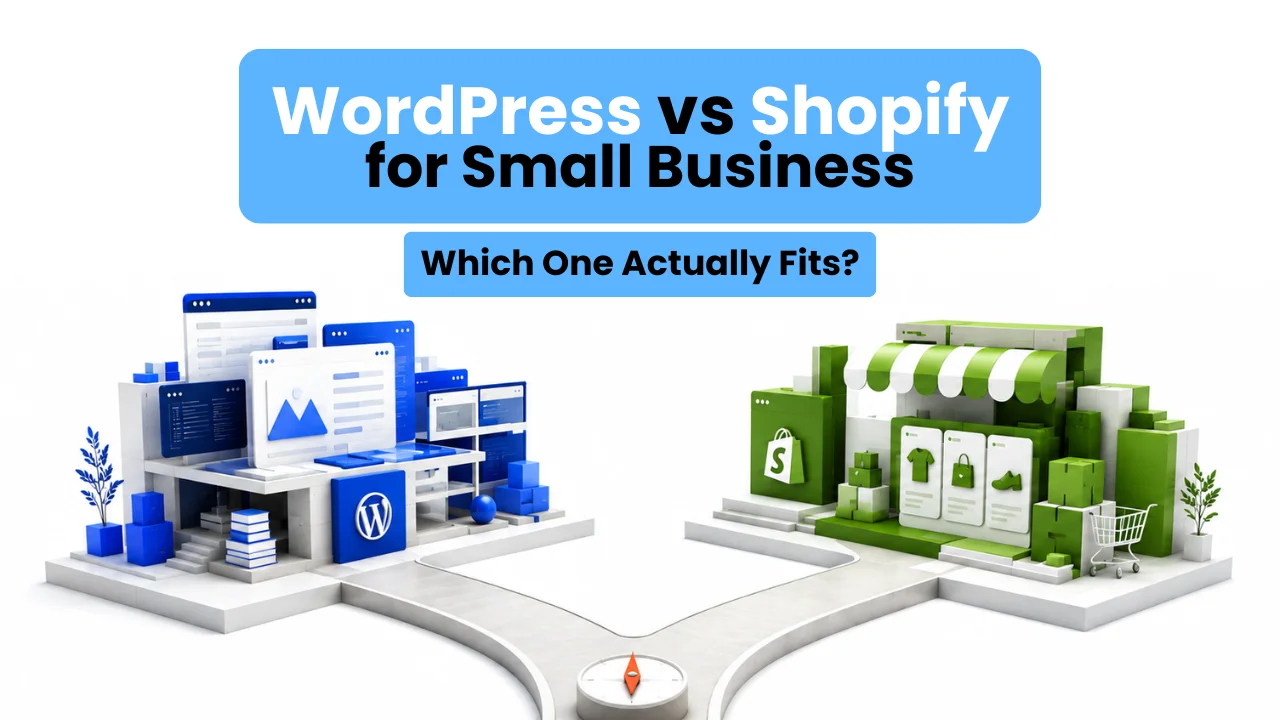
WordPress vs Shopify for Small Business: Which One Actually Fits?
Key Takeaways
|
A lot of WordPress vs Shopify comparisons start with the assumption that you already know you want to build an online store. From there, they spend thousands of words comparing checkout options, themes, apps, and payment features.
But that isn’t where every business starts.
If you’re a consultant, a local service business, a course creator, or a content-focused brand, your needs can look completely different from a business selling physical products online.
So instead of asking which platform has the better store features, it makes more sense to step back and ask a bigger question: which platform actually fits the way your business works?
That’s what this guide is about. Rather than focusing only on which platform can build the better store, we’ll look at how WordPress and Shopify fit different types of businesses, what each platform does well, and which one makes the most sense for you.
What Are You Actually Building?
Before any feature comparison matters, this question decides almost everything else.
- Mostly content or services. A consultant, agency, local business, course, blog, or portfolio site where selling, if it happens at all, is secondary to information, trust, and lead generation. This points toward WordPress.
- Mostly a product catalog. The business exists to sell physical or digital products, with content playing a supporting role at most. This points toward Shopify, or WordPress with WooCommerce, covered further down.
- A genuine mix. A service business that also sells a handful of products, or a content brand that wants a small store attached. This is the case most comparison guides skip, and it usually favors WordPress, since adding e-commerce to a content site is easier than adding serious content tooling to a store platform.
What Is WordPress, and What Is Shopify?
WordPress is free, open source software you install on your own hosting. It started as a blogging tool and grew into a full content management system, confirmed as the most widely used CMS on the web by W3Techs, running 40.8 percent of all websites as of August 2026. It does not sell anything by default. Selling requires adding a plugin, most commonly WooCommerce.
Shopify is a fully hosted, subscription-based platform built specifically to sell things. You pay monthly, Shopify handles hosting, security, and checkout, and you customize within its ecosystem of themes and apps. Content tools exist, but they were added onto a commerce platform rather than the other way around.
Platform market share as of August 2026. Sourced directly from W3Techs, not a secondary summary.
WordPress vs Shopify: The Side-by-Side Numbers
| Factor | WordPress | Shopify |
|---|---|---|
| Starting cost | Free software, hosting typically $20 to $50/month for a managed plan | Basic plan $39/month ($29/month billed annually) |
| Setup time | Days to a couple of weeks, longer with custom design or a developer | Hours to a couple of days for a basic store |
| Ease of use | Steeper learning curve, more decisions to make | Designed for non-technical users from the ground up |
| Customization | Effectively unlimited, full code access | Customizable within the platform’s themes and app ecosystem |
| Content and blogging | Built for this from the ground up | Improved, but still secondary to the store |
| Hosting and security | Your responsibility, or your host’s | Fully managed by Shopify |
| Selling products | Requires WooCommerce or another plugin | Native, built in from day one |
Is Shopify Still Behind WordPress on SEO in 2026?
Less than it used to be. WordPress remains the stronger platform for content-heavy SEO strategies, since plugins like Rank Math and Yoast give granular control over metadata, schema, and internal linking, the fundamentals that matter most for a business relying on blogs or long-form content to drive organic traffic.
But Shopify has made real progress in 2026. Its built-in SEO tools now cover the basics most stores need without installing anything extra, which was not true a few years ago. If a business’s SEO strategy is mostly product pages and category structure, Shopify’s native tools are now genuinely competitive. If the strategy leans on blogging, guides, or content marketing to drive traffic, WordPress still has the clearer advantage.
When Should a Small Business Choose Shopify?
- The business is a straightforward product catalog with no need for a content-heavy blog or complex service pages.
- There’s no developer on the team, and the owner wants to be selling within days, not weeks.
- Predictable monthly cost matters more than long-term flexibility.
- The business plans to sell heavily through social channels, where Shopify’s integrations are strong.
If this sounds like your business, a conversion-optimized Shopify storefronts with a custom theme can give you the flexibility and functionality you need for a strong launch.
When Should a Small Business Choose WordPress?
- Content, blogging, or long-term SEO strategy is core to how the business plans to grow.
- The business is primarily service-based, informational, or lead-generation focused, not a product catalog.
- Full control over design, functionality, and data ownership matters, without being tied to one vendor’s ecosystem.
- There’s a developer involved, or a plan to bring one in, who can set up hosting and security properly.
If this sounds closer to the business in question, I build custom, SEO-ready WordPress websites built for speed and long-term flexibility rather than locked into a single vendor’s platform.
What If You’re Planning to Sell Products Too?
This is where the decision gets more specific, and where this post intentionally stops going deeper. If content and service pages are the main goal and a product catalog is a secondary feature, WordPress with WooCommerce is usually the better starting point, since bolting commerce onto a content site is more natural than the reverse.
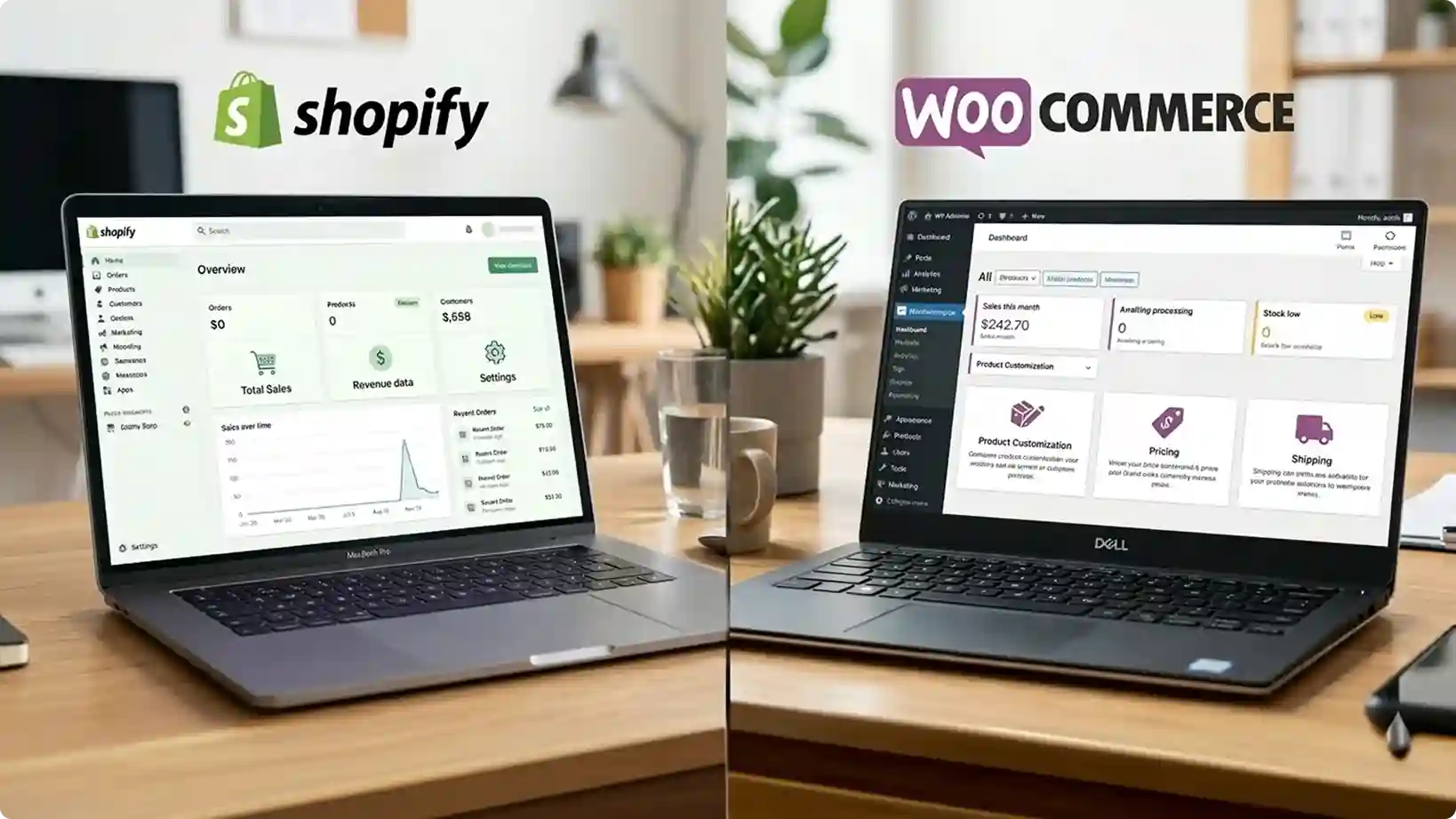
But if selling products is actually the whole plan, the real decision isn’t WordPress vs Shopify anymore, it’s WooCommerce vs Shopify specifically. We already have full breakdown of that exact comparison: WooCommerce vs Shopify: Which Platform Should Your Business Actually Choose?, covering pricing at scale, payment gateways, and reliability in more depth than makes sense to repeat here.
Shopify’s third-party gateway fee scales with revenue. WordPress and WooCommerce carry no platform-level transaction fee.
| One number worth sitting with: at $50,000 a month in revenue, a Shopify Basic store using a third-party payment gateway pays roughly $1,000 a month in platform fees alone, on top of the plan cost. That number and the full cost breakdown behind it are covered in detail in the WooCommerce vs Shopify post linked above. |
Can You Switch Platforms Later If You Choose Wrong?
Yes, but it’s not a quick fix. Both platforms have migration tools, and professional migration services exist for both directions. The real cost isn’t technical, it’s disruption: a poorly planned migration risks broken URLs, lost SEO rankings, and customer data headaches. That’s exactly why getting this decision right at the start, based on what the business actually is rather than which platform is trending, saves real time and money down the line.
Frequently Asked Questions
Is Shopify better than WordPress for a small business?
It depends entirely on what the business sells. Shopify is generally the faster, simpler choice for a straightforward product catalog with no complex content needs. WordPress is generally the stronger choice for service businesses, content-driven brands, or anyone who wants full control over design and data without being tied to one platform.
Can WordPress do what Shopify does?
With the WooCommerce plugin added, yes, WordPress can run a full online store, and often more flexibly than Shopify once custom requirements are involved. The tradeoff is that WordPress requires more setup and technical management than Shopify’s fully managed approach.
How much does a WordPress site cost compared to a Shopify store?
WordPress itself is free, with hosting typically running $20 to $50 a month for a properly managed plan, plus any premium plugins or themes. Shopify’s Basic plan starts at $39 a month ($29 billed annually), with the platform’s own transaction fees added on top if a third-party payment gateway is used instead of Shopify Payments.
Is WordPress harder to use than Shopify?
Generally yes, at least at first. Shopify was designed from the ground up for non-technical users, while WordPress involves more setup decisions, hosting choices, and plugin configuration. That gap narrows significantly with a developer involved, and WordPress’s learning curve buys real flexibility in return.
Should I choose WordPress or Shopify if I’m not sure yet whether I’ll sell products?
Lean toward WordPress. Adding a store to a content-first WordPress site later, through WooCommerce, is a natural extension. Adding serious content and blogging capability to a Shopify store after the fact is a much harder retrofit, since Shopify’s tools were built for commerce first.
About the Author
Abdul Basit RK, Freelance Web Developer
Abdul Basit RK is a Top Rated Plus freelance web developer with over 7 years of experience building fast, secure, conversion-focused websites on WordPress, WooCommerce, Shopify, Webflow, and HubSpot. He helps small businesses choose the right platform for their actual goals, not the one with the loudest marketing.